






Geometric wall sticker ideas for modern rooms can range from one bold polygonal focal point to a restrained arrangement of lines, circles or angular shapes. Because Apex wall stickers are cut from one-colour self-adhesive vinyl, they sit directly against the wall without a printed, white or clear background. The result is a crisp, painted-on look that works especially well with modern, Scandinavian and minimalist interiors.
Quick answer: which geometric style should you choose?
Choose a design by matching its visual weight to the room. Large angular decals suit uncluttered feature walls, while small repeated shapes can add rhythm to bedrooms, workspaces and hallways. Dark navy, black and charcoal create strong contrast; a colour closer to the wall tone produces a quieter effect.
| Room style | Geometric approach | Best placement | Trade-off |
|---|---|---|---|
| Minimalist | One large outline or polygon | Above a sofa, bed or desk | Clean and calm, but positioning needs care |
| Scandinavian | Simple triangles, arches or abstract lines | Reading corner or bedroom wall | Soft and versatile, but subtle colours may have less impact |
| Contemporary | Asymmetrical angular composition | Main feature wall | Striking, but can compete with busy furniture |
| Creative workspace | Grid, fragmented lines or grouped shapes | Behind or beside a desk | Adds energy, but too many elements can feel distracting |
| Small room | Compact vertical or corner arrangement | Beside furniture or in an alcove | Uses limited space well, but needs breathing room |
If you already know that an angular focal point will suit your space, explore the geometric and polygonal wall stickers collection. For a broader starting point, compare it with the full range of self-adhesive wall stickers.
What you need before you start
A successful geometric arrangement depends as much on the wall and surrounding furniture as it does on the decal. Before ordering or applying your design, check the following:
- A suitable surface: Wall stickers work best on smooth, clean, dry surfaces. Heavily textured walls can prevent the vinyl from making even contact.
- A properly cured wall: Freshly painted walls should cure before applying stickers. Follow the paint manufacturer’s stated curing time rather than relying on the wall feeling dry.
- Reliable measurements: Measure the usable wall area, not the whole wall. Allow for shelves, sockets, radiators, headboards and furniture.
- A clear focal point: Decide whether the sticker should anchor a sofa, frame a desk or fill an otherwise empty section.
- A colour plan: Compare the vinyl colour against both the wall and the room’s major furnishings. Strong contrast feels graphic; low contrast feels softer.
- A clean surface: Remove dust and allow any cleaned area to dry fully before application.
Paint quality and surface condition affect how well a sticker applies and how it behaves when removed. Removal results depend on wall condition, paint quality and how carefully the sticker is removed.
Step-by-step: plan a geometric wall sticker arrangement
Geometric wall styling checklist
- Choose the visual mood — use angular forms for energy, rounded geometry for softness or simple lines for a restrained look.
- Measure the usable wall — account for furniture, fittings and the empty space needed around the decal.
- Select the scale — choose one large focal design or a smaller arrangement that complements rather than crowds the room.
- Set the position — align the design with a bed, sofa, desk or architectural feature instead of centring it on the wall automatically.
- Check colour contrast — view the vinyl colour against the wall in both daylight and evening light.
- Prepare the surface — make sure it is smooth, clean, dry and fully cured before applying the sticker.
- Apply carefully — follow the supplied guidance and smooth the vinyl evenly onto the wall.
1. Decide how energetic the room should feel
Geometry can change the apparent mood of a room. Sharp triangles, fragmented polygons and diagonal lines suggest movement. Circles, arches and wide curves feel gentler. Repeated squares or grids create order, while an asymmetrical composition feels more expressive.
For a calm bedroom, use fewer shapes and leave generous empty wall around them. A home office can handle a slightly more active design, particularly when it is positioned behind the desk rather than directly in your main sightline.
2. Choose between a focal decal and a repeated pattern
A single large design is usually the simplest route to a polished modern feature wall. It creates a clear focal point and avoids the visual noise that can occur when lots of small elements are spread across a room.
Repeated motifs are more flexible. They can travel up a narrow wall, form a loose cluster or draw attention to an awkward corner. The trade-off is that spacing becomes more important. If each element is supplied separately, plan the complete arrangement before applying the first piece.
3. Match the design to the furniture, not just the wall
A decal rarely appears in isolation. Its relationship with furniture determines whether the finished wall looks intentional. Above a sofa or headboard, keep the main design visually connected to the furniture while leaving enough separation for it to breathe. Beside a desk, a vertical arrangement can balance shelves or a tall lamp.
Do not assume that the mathematical centre of the wall is the best position. In an open-plan room, the visual centre may be above the main furniture group. In a bedroom, it may relate to the headboard rather than the full width of the wall.
4. Pick a colour with the right amount of contrast
Black and charcoal geometry looks crisp against white, pale grey and many soft neutral walls. Dark navy offers similar definition with a slightly softer character and works particularly well alongside grey upholstery, pale wood and navy accessories.
For a more understated effect, choose a colour that is deeper than the wall but belongs to the same overall palette. Remember that natural and artificial light can change perceived contrast. Check the wall at different times of day before making a final colour decision.
5. Use negative space as part of the design
Modern rooms rely on visual breathing room. A geometric sticker does not need to fill every available centimetre. In fact, open wall around the design often makes its outline more legible and gives the room a more considered finish.
As a starting point, avoid squeezing a decal tightly between furniture and the ceiling or placing it too close to shelving, frames and wall lights. If the room already contains patterned textiles, open shelving or several decorative objects, choose a simpler vinyl design.
6. Prepare and apply the sticker
Check that the wall is smooth, clean, dry and free from dust. If it has recently been painted, wait until the paint has fully cured according to the manufacturer’s guidance. Temporarily position the design and view it from the doorway and the usual seated position before applying it.
Follow the instructions supplied with your decal. Work methodically and smooth the vinyl evenly, taking particular care around narrow points and fine lines. Large designs may be easier with another person helping to hold the material steady.
Geometric ideas for different modern rooms
Living room: anchor the seating area
Use one substantial polygonal or abstract line design above the sofa, sideboard or reading chair. A wide composition helps connect a long piece of furniture to the wall. If you have cushions or a rug with strong patterns, select simpler geometry to prevent competition.
Bedroom: create a calm headboard feature
Choose balanced lines, overlapping circles or a restrained angular silhouette. A design placed above the headboard can define the sleeping area without filling the entire wall. Rounded geometry generally feels calmer than a dense cluster of sharp forms.
Home office: add structure without clutter
A compact grid, line design or vertical polygon can give a workspace identity while keeping floor and desk surfaces clear. Position active, high-contrast geometry behind the monitor or to one side if you find busy shapes distracting during focused work.
Hallway: make use of narrow wall space
Hallways often suit slim vertical arrangements or small geometric clusters. Repetition can guide the eye along the space, but keep enough distance from door frames, switches and coat storage. A simplified design is easier to appreciate while passing through.
Scandinavian-inspired room: keep it restrained
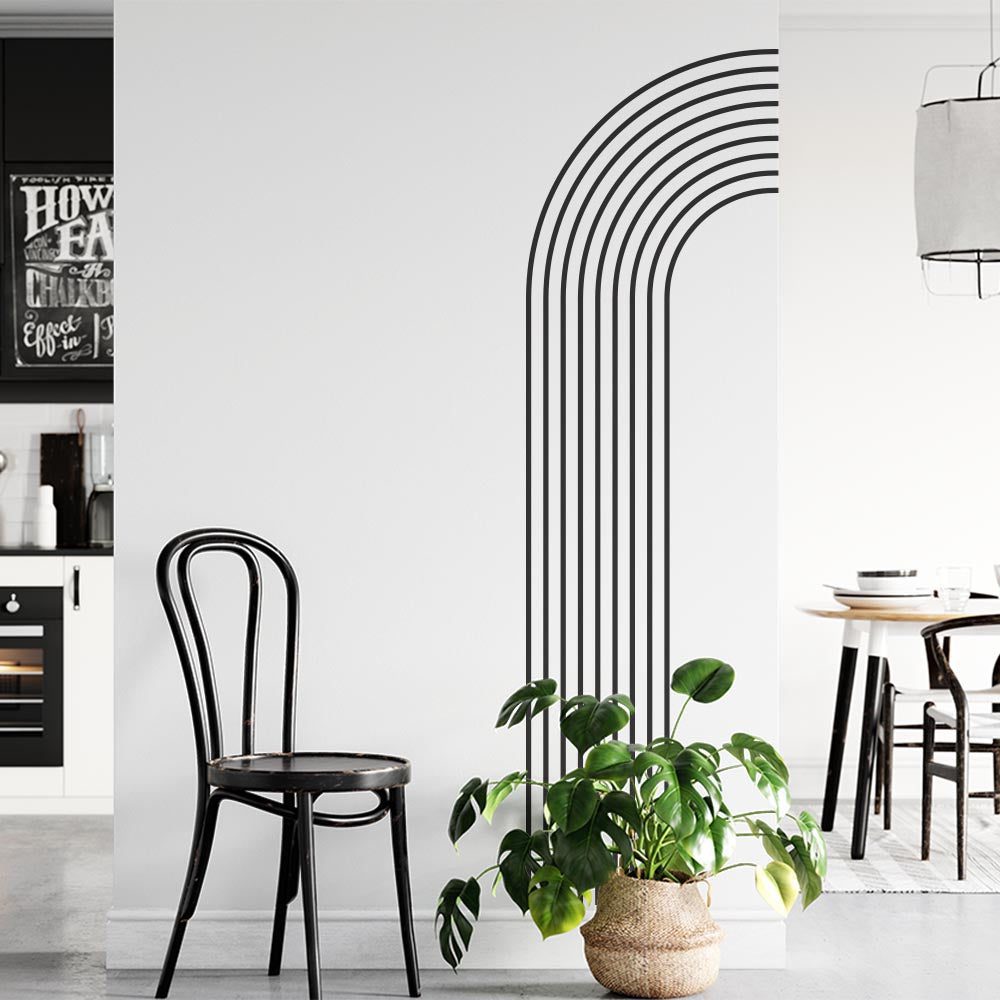
Combine pale walls and natural textures with a simple one-colour arch, triangle or line-based decal. The aim is not to fill the wall but to give it a quiet point of interest. Browse Scandinavian wall sticker designs if softer simplicity suits your room better than strongly faceted geometry.
Colour-led interior: extend the palette
If your main goal is to bring blocks of colour into the room rather than create a sharply outlined motif, consider colour block wall stickers. They can produce a broader visual area, while geometric cut-vinyl decals tend to emphasise silhouette and line. The right choice depends on whether you want colour mass or a crisp graphic form.
Common mistakes to avoid
- Choosing a design that is too small: A tiny decal can look disconnected above a large sofa or bed. Measure the furniture as well as the wall.
- Filling every gap: Geometric décor needs negative space. Crowding the design with frames, shelves and plants can weaken its impact.
- Ignoring viewing distance: Fine detail may disappear across a large room, while very bold shapes can overwhelm a narrow space.
- Using too many competing patterns: Strong rugs, curtains, bedding and wall geometry can make a room feel restless.
- Applying to an unsuitable surface: Rough, dusty, damp or poorly bonded paint can affect adhesion and removal.
- Applying to fresh paint too soon: Dry-to-touch paint is not necessarily cured paint.
- Positioning by wall centre alone: Relate the sticker to furniture and normal sightlines for a more cohesive result.
- Expecting a printed effect: One-colour cut vinyl creates a clean silhouette; light details are formed by the wall showing through as negative space.
When to choose a different product or approach
Geometric cut-vinyl stickers are particularly effective when you want crisp one-colour shapes and a clean, background-free finish. However, another approach may suit your project better in the following situations:
- The wall is heavily textured: Consider freestanding artwork or décor that does not rely on broad contact with the surface.
- You want a full-wall multicolour scene: A one-colour cut-vinyl decal is not the same as printed wallpaper or a mural.
- The paint is fresh or unstable: Allow fresh paint to cure. If existing paint is flaky, chalky or poorly bonded, address the surface before considering a sticker.
- The room already has dominant geometry: If the flooring, curtains and furniture are strongly patterned, a botanical silhouette or simpler wall accent may provide better balance.
- You need maximum flexibility: Framed prints or moveable accessories may be more appropriate if you regularly rearrange the room.
- You want broad fields of colour: A colour-block design may suit the concept better than a detailed polygonal silhouette.
Frequently Asked Questions
Do geometric wall stickers suit small rooms?
Yes. Choose a compact or vertical design and preserve empty space around it. A single clear motif often works better than many scattered shapes in a small room.
What colour geometric wall sticker works with grey walls?
Black and dark navy provide strong contrast on pale grey. White may work on mid-to-dark grey, while charcoal can create a subtle tonal result. Check the contrast in the room’s actual lighting.
Can I apply a geometric sticker to a freshly painted wall?
Wait until the paint is fully cured, following the paint manufacturer’s guidance. Applying vinyl before curing is complete can affect both adhesion and the painted surface.
Are wall stickers suitable for textured walls?
They work best on smooth, clean, dry surfaces. Texture reduces the contact area and may make fine lines or pointed geometric details harder to apply evenly.
Can geometric wall stickers be removed?
They can be carefully removed, but outcomes vary. Removal results depend on wall condition, paint quality and how carefully the sticker is removed.
Find a geometric design for your room
The most effective geometric feature is not necessarily the busiest one. Choose a scale that relates to your furniture, a colour with suitable contrast and a shape that reinforces the mood you want. If you are planning a clean, modern update, browse the geometric and polygonal wall stickers collection for one-colour self-adhesive designs that work best on smooth, clean, dry walls.